
TLDR: No, SG Hindu Community’s Fertility might be lower than South Korea’s, we contributed only $11 extra while incomes have doubled over the last 10 years, the entire Hindu community is being sustained by a group of volunteers who do multiple things, a majority of Hindus may not even visit the temple annually.
Let’s take an easy benchmark: population.
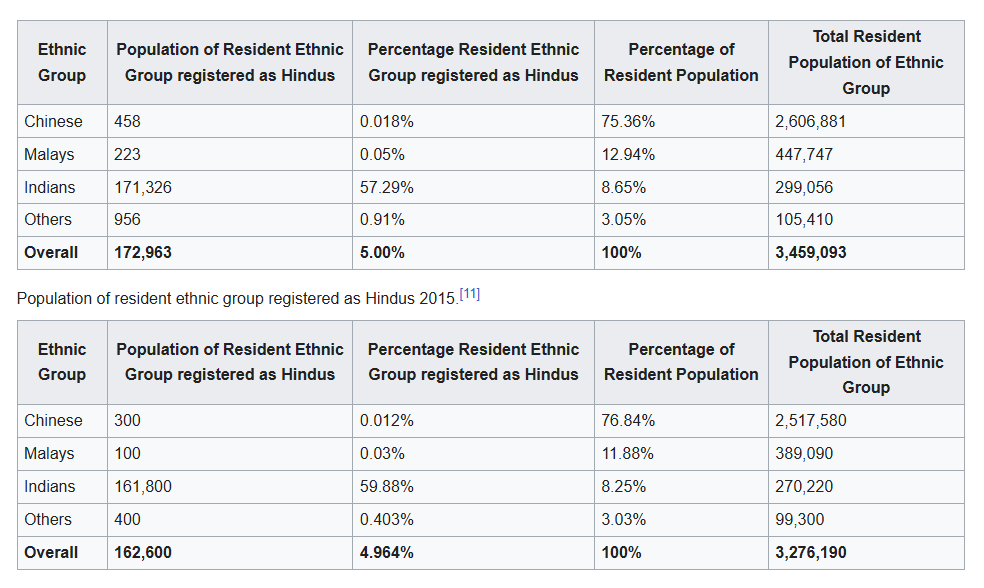
The population of citizens in Singapore has increased by 5% from 2015 to 2020. The Hindu population has risen by about 6% (see tables below), which appears to be in line with the wider population growth. But how much of this growth is due to new citizens, versus the growth of the existing Hindu population? Singapore’s total fertility rate (TFR) statistic for the Indian community cannot inform us about local Hindu growth as the statistic does not reflect the Hindu population specifically.
For example, due to religious and cultural reasons, the Indian Muslim TFR might be closer to the Malay (exclusively Muslim) TFR, which is 1.65–1.8, rather than the Indian TFR, which is 0.9. In this case, the births within the Indian Muslim community would account for a larger proportion of local Indian births (127 births a year out of total 270 Indian births a year) resulting in the Non-Muslim Indian birth rate of 0.6. This would mean that as a population, our TFR may be lower than the lowest TFR globally (South Koreans, at 0.7). Given that Hinduism does not proselytize, and our main way of passing on Hinduism is through family ties, this should be a cause for worry and a reason to reevaluate how we practice and sustain Hinduism in Singapore.
In the future, the Hindu community may depend more on new citizens, which has both positives and negatives. Will it be more challenging to sustain local practices specific to Singapore? For example, with the regular influx of new citizens to the local Hindu community, we may import less empowering elements such as wanting to depend purely on government support for Temple upkeep and functions.
2020
2015
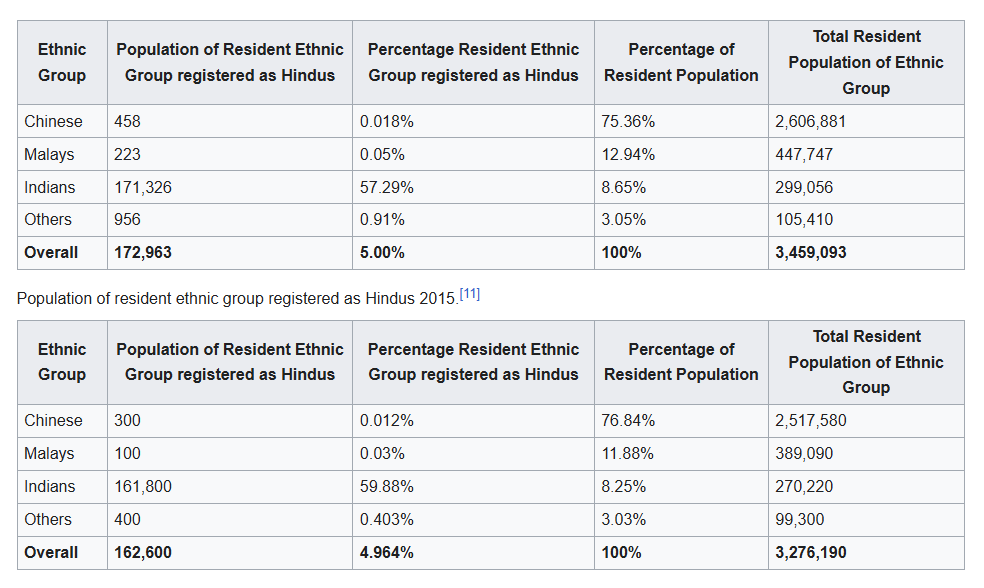
Population of Hindus in Singapore in 2020 (top table) and 2015 (above). Source: Census (Wikipedia)
Even among Singaporean Hindus, support for temples is already an area that needs improvement. From 2010 to 2020, Indians’ monthly income from work has increased the most at 2.25% per annum (40% over 10 years, see table below). If we take the HEB statements as a representation of Hindu temples in Singapore, temple donations have increased by 78% from 2013 to 2022, reaching a total of $4.4 million. This may sound like a lot. But if we divide this amount by the number of Hindu citizens in Singapore, it is a mere $11/year. This is not much considering that the median Indian household income has increased by $2,500 a month (see table below). Given that every Hindu household would interact with a HEB temple at least once or twice annually, it seems that our growth in wealth is not being channeled to our faith.
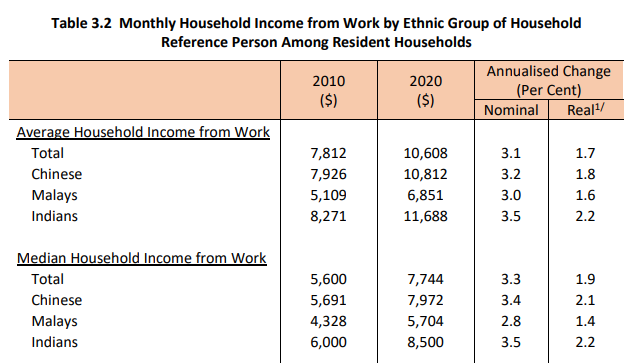
The median household income from work has increased the most for the Indian population. Source: Singapore Census 2020
We noticed this trend in 2018 when we conducted a survey with 300 Hindu participants to understand their views on Hinduism. We realized that Hinduism in Singapore is sustained by concentric circles of devotees where the core demographic (maybe a few thousand) of volunteers are pretty much involved in all 28 temples and over 30 organizations. Over 46% of respondents only visited temples once a year and didn’t partake in any other religious activity.
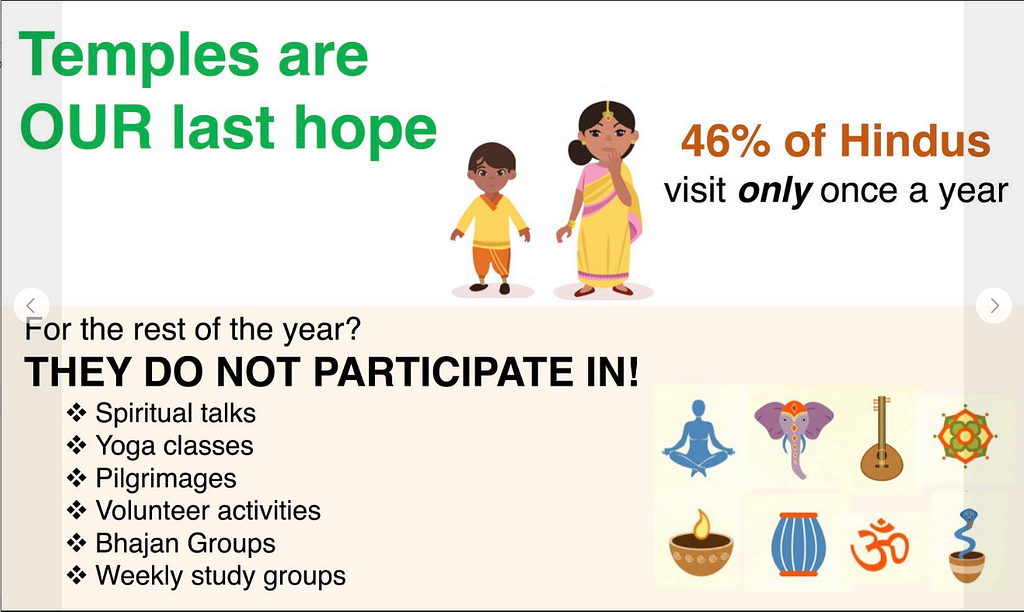
Excerpt from the 2018 survey’s findings.
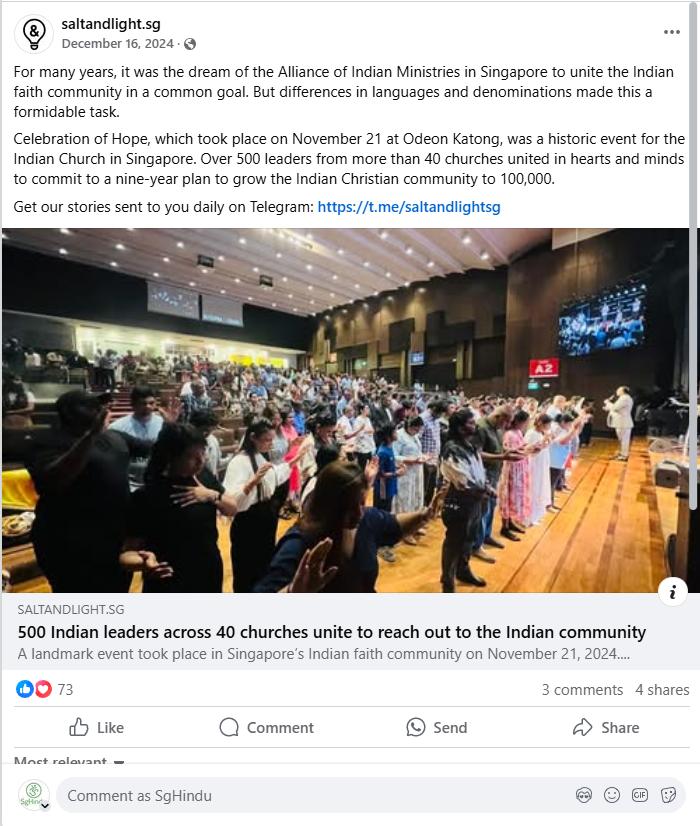
The aim of the rest of this series is not to discuss the problems with teaching our beliefs or what needs to be improved in the Hindu community. We covered these at length in a viral article on whether Hindus had any standing to negotiate with the government regarding the Thaipusam issues between 2016–2018 (tldr; we don’t because we are not organized enough). We have come to realize that fellow ancient traditions in Singapore such as Taoism are struggling with these issues as well. At its current rate of decline, there may be no Taoists left in Singapore in 40 years. We are highly cognizant that as a small team of Hindu volunteers, we are outclassed in the digital realm by other local religious publications such as Salt&Light or MuslimSG which are sponsored by their main religious bodies and have 20 times the number of followers online.
Instead, we would like to share some of our key learnings from the past decade as a result of our Karma. We hope that these will be beneficial to other Hindus organizations or individuals looking to serve the community. We present these as our Dakshina to grow our Dharma in Singapore.
Read the next part here.