
The Mahishasura Mardini Stotram: From Heavy Trance to Heavy Metal
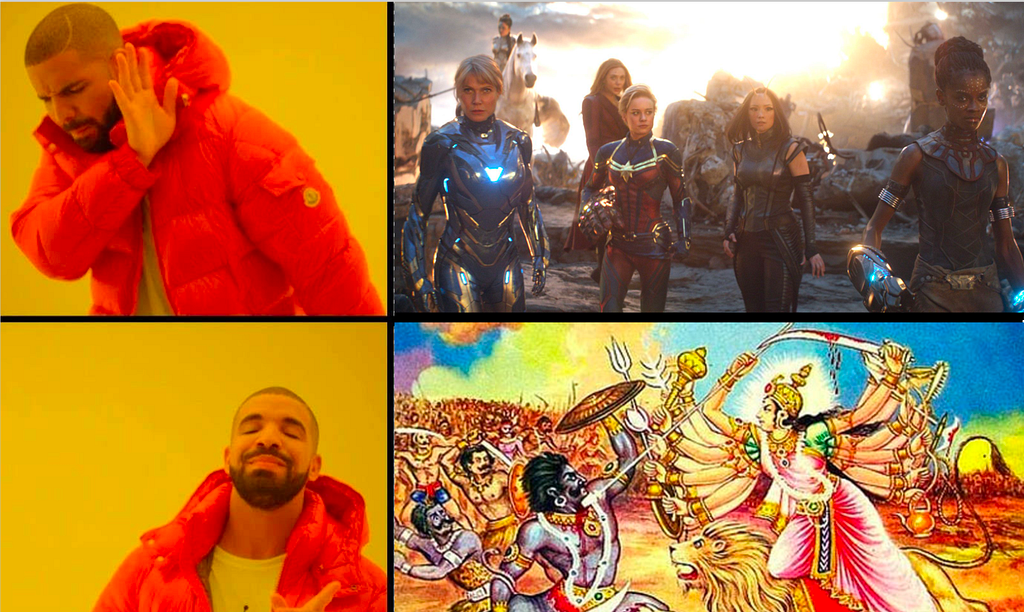
If you were one of those people who clapped and cheered at the Avenger’s heroines’ scene in 2019, we want to introduce you to a 500-year-old poem of a warrior Goddess riding a tiger and killing a buffalo demon instead.
Hinduism is the only major world religion to worship the feminine divine, and every year, nine days are dedicated to the various forms of the Goddess, mirroring the transformation that women undergo in their lives and the amazing qualities that they exhibit. Some of these forms and practices defy colonialist and Western norms (such as using the soil from a brothel to make the Mother Goddess’ statue) which brings society’s attention back to the treatment of women even outside social norms.
Driving this devotion is the Mahishasura Mardini Stotram, written by Ramakrishna Kavi (better known as Tenali Raman) five centuries ago. This particular story is interpreted to have happened in a parallel universe where the Earth was very different from ours. In the story, a buffalo demon named Mahishasura had a boon that no man could kill him. (Sound familiar to LOTR fans? The original Witch King of Angmar situation, if you will). So the Gods, with all their powers combined, revealed the true source of their inner power by creating the perfect woman, who singlehandedly takes on Mahishasura’s entire army and brutally kills the demon. She is then named Durga, the “undefeatable”. See why we choose this tale over the Avengers?
The test of a work of art, is its longevity and how many remakes it spawns. While Michael Jackson may have been the greatest performer of all time, Mozart’s creations are still preferred in movie scores. The Mahishasura Mardini Stotram might be one of most inspiring works from Hinduism. Even in Devi worship, this tune is played at the end as a crescendo which verily drives many into a trance. However, what is truly divine is the number of musical remakes it has inspired.
Classical
So first, you need to hear what the classical version sounds like. It gives you a good idea of the tune and rhythm of the hymn. It’s also ridiculous how much meaning is packed into such a simple tune.
Reggae
It’s particularly perplexing how a Swedish Reggae band came to cover the Stotram. They gave a battle hymn a relaxing, swirling, chilled out vibe. The Stotram is interspersed with commentary about who the Goddess is, making it one of my favourite ways to introduce the Stotram to a non-Hindu.
Heavy Trance
Shanti People is a force to be reckoned with on the Dharmic music scene and Hindus will only see their value in years to come. They focus on reinterpreting Vedic Mantras as electronic dance music and you can see that the focus Hinduism places on chanting and rhythm allows this artistic expression. A Czech band that has sneaked the Stotram into trance raves worldwide can only be described as a force of Devi herself.
Heavy Metal
Probably the most aggressive genre that expresses war the best, it’s no surprise that Mahishasura Mardini has been the subject of many heavy metal songs. J Mascis, a renowned American guitarist, tries his hand at reinterpreting the Stotram and rearranges the tune slightly to fit the song.
Lastly, from Singapore, we have Rudra that focuses on the tune and the meaning without actually chanting it. This rendition mirrors the tempo that is usually used in Pujas. The drumming is definitely inspired by the rhythms of the Mridangam, which are difficult to reproduce on a contemporary drumkit (notice both his legs providing the bass beats simultaneously).
So which is your favourite rendition? Let us know of any other amazing Hindu art out there!